
How Open Should a Duduk Reed Be?
A Practical Guide
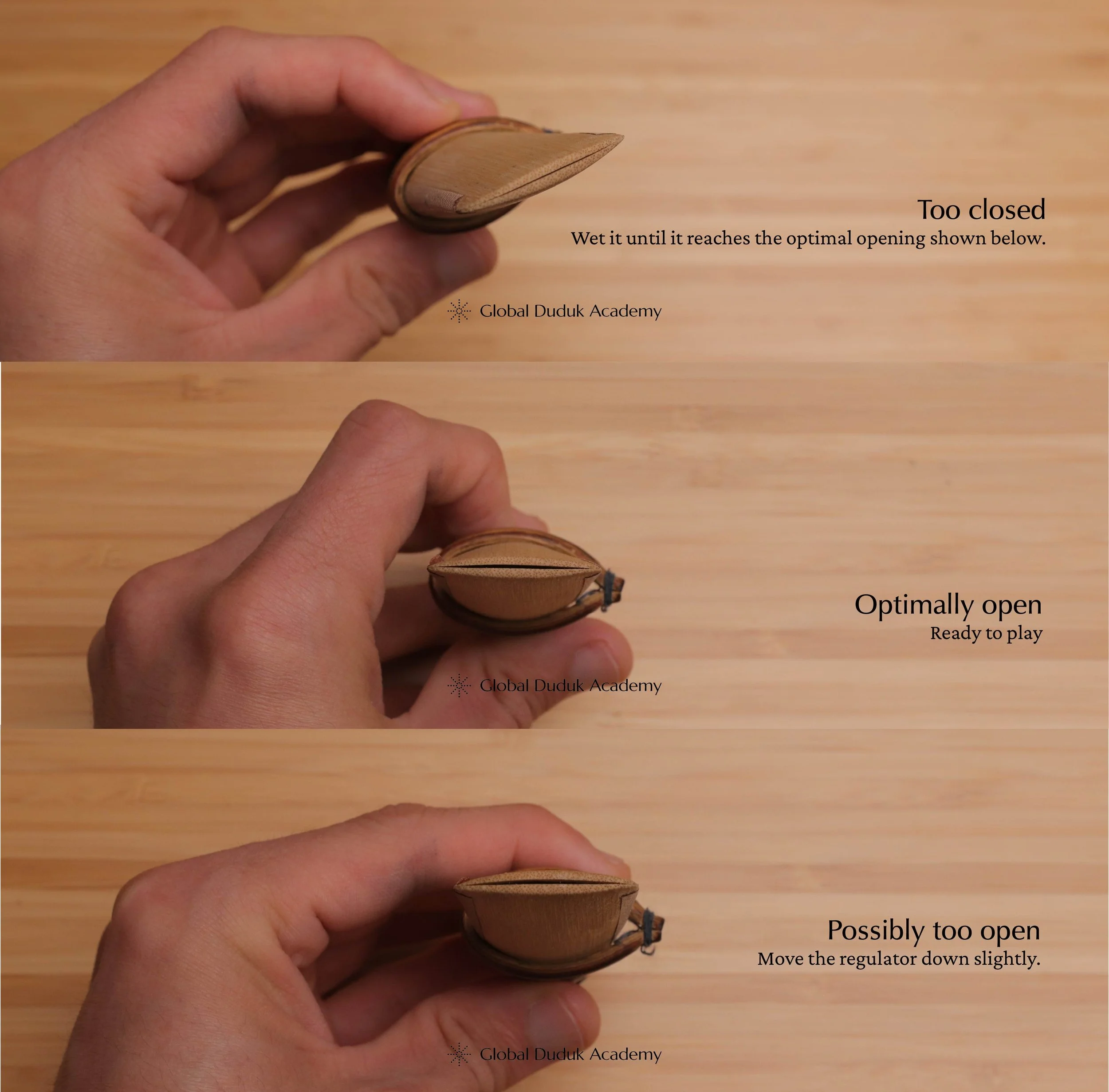
The correct opening cannot be determined by appearance alone. It may vary slightly from one reed to another. Always evaluate the opening together with the reed’s response, resistance, sound, and tuning.
How to wet, open, adjust, and tune your reed before and during playing
1. Why Reed Preparation Matters
The reed changes depending on the type of reed, moisture, temperature, humidity, and how long you have been playing.
There is no single wetting time or regulator position that works for every reed.
The goal is to learn what to observe and feel rather than following a fixed number of seconds.
2. Before You Wet the Reed
Check how open or closed the dry reed is.
Do not force the reed open by pressing it from the sides.
If the reed is already sufficiently open, wetting it briefly in your mouth once or twice may be enough.
3. How to Wet the Reed
Wet the reed before playing.
Wet the first 3–5 cm of the reed from the tip in your mouth.
Begin with a short wetting period rather than soaking it excessively.
Give the reed time to absorb the moisture and respond before wetting it again.
The reed is ready based on its opening, flexibility, response, and sound—not only on how long you have wetted it.
If you have been using the reed regularly, it will usually open more quickly. If it has been dry or unused for a while, it may take longer to open the first time.
If you need to push the regulator very far down to close the reed, you have probably wetted it more than necessary.
4. Check the Reed Opening
Use the photographs as three visual references:
Too Closed
The reed may feel resistant or may not respond freely.
The sound may be restricted.
The pitch will generally be higher.
Ready to Play
The opening is neither compressed nor excessively wide.
The reed responds comfortably.
It produces a full, stable sound.
It allows normal tuning adjustments.
Too Open
The reed may require too much pressure and air.
It may become difficult to control.
The pitch will generally be lower.
You may feel that you need to press the reed with your lips to produce a stable, controlled sound.
5. How the Reed Opening Affects Tuning
The opening of the reed directly affects the tuning of the duduk.
A more open reed generally lowers the pitch.
Lowering the regulator closes the reed and generally raises the pitch.
Raising the regulator opens the reed and generally lowers the pitch.
The regulator therefore affects both the reed’s opening and the tuning. It does not only make the reed easier or harder to play.
However, the regulator is not the main tuning tool. Do not try to tune your duduk using only the regulator.
6. Find a Playable Opening Before Tuning
First, bring the reed to a healthy, playable opening.
Check whether it responds comfortably and produces a full sound.
Then check the tuning.
Do not close the reed excessively just to produce the correct note on a tuner.
A reed can appear to be in tune while being too closed to respond or sound properly.
7. Adjust the Regulator
Move the regulator in very small steps.
After each adjustment, play again and listen.
Check the response, resistance, sound, and pitch together.
Do not copy the regulator position of another reed: every reed is different.
Never force the regulator beyond the point where it moves comfortably.
8. How to Know Whether the Reed Is Ready
The reed is ready when:
The opening looks appropriate.
It responds without excessive effort.
It produces a full, stable sound.
The resistance feels manageable.
The duduk can be brought into tune without closing the reed excessively.
The correct opening cannot be determined by appearance or by a tuner alone. Opening, response, sound, resistance, and tuning must be evaluated together.
9. When to Wet the Reed Again While Playing
Do not automatically wet the reed again after a fixed number of minutes. Check whether:
The reed is beginning to close.
It feels drier or less flexible.
The upper notes are becoming sharper.
The response has become more difficult.
The sound has become restricted.
The tuning has changed because the opening has changed.
If the reed has closed only slightly, wetting it briefly in your mouth once or twice may be enough. You may not need to move the regulator at all.
If the reed still responds well and remains stable, it does not need to be wetted again.